
Read Peach County’s Owner-of-Record Card
Start with the Peach QPublic gateway, the county's official parcel search. Its live parcel card carries the ownership fields a visitor relies on. Labels can shift from one display to the next. Save the exact wording you see, along with the date of the display. That way your owner-of-record evidence stays defensible.
| Owner name | The taxpayer or owner of record as displayed |
|---|---|
| Mailing address | Where assessment or tax correspondence goes |
| Situs address | The location of the parcel itself |
| Parcel/account | The current cross-system identifier |
| Sale/deed reference | A lead to the recording, if the card supplies it |
| Transfer date | A clue to when the present record changed |
The owner of record is not always the occupant. A mailing address helps with lawful property correspondence. But it may point to a post-office box, a business office, or a trustee. Treat it as a contact route only. The Board of Tax Assessors page leads to the county's owner display and its supporting details. When a field is suppressed, leave it blank rather than filling it from an unofficial people finder.
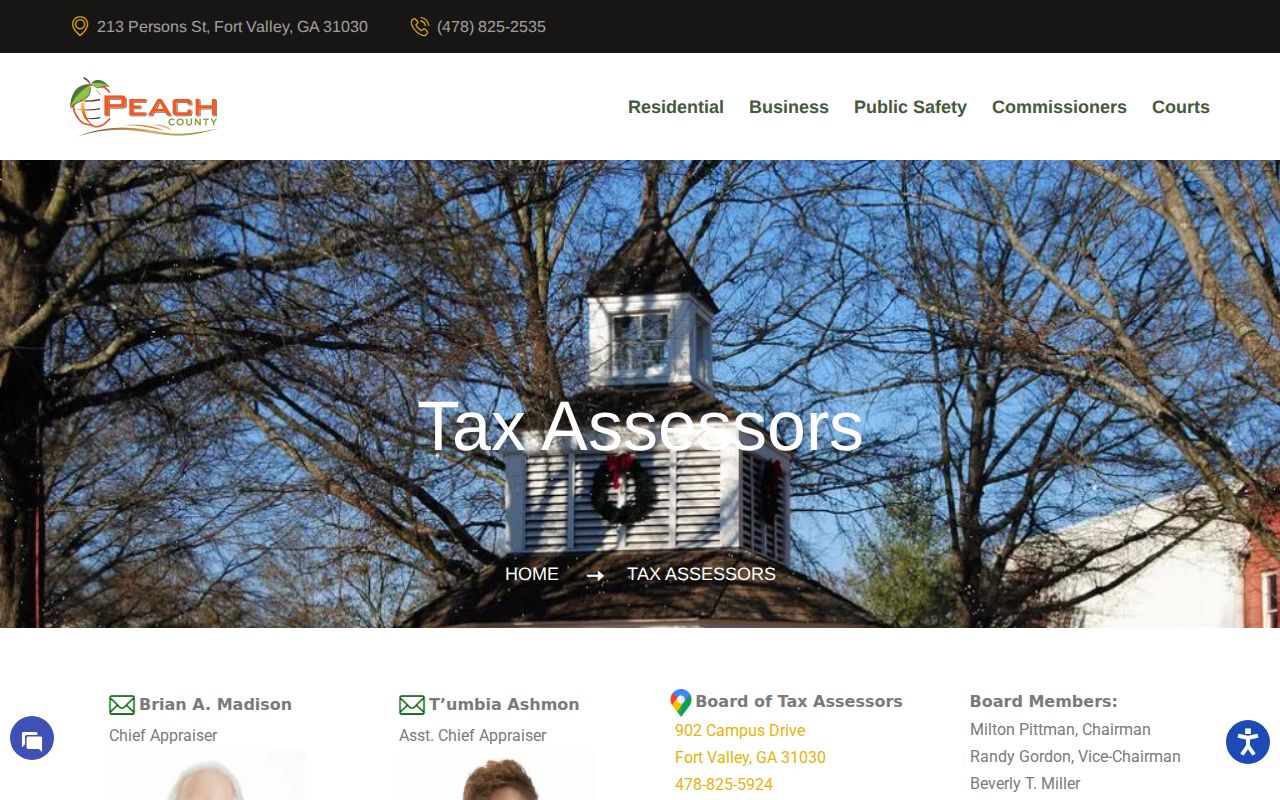
When the live parcel card is unreachable, the assessor's official office page provides the contact route for ownership questions.
Check the Peach County Recording Gap
The assessor investigates ownership and reviews parcels each year, but its roll exists for valuation. A deed can be recorded days before the parcel card catches up. So a recent sale demands honesty. State "assessor displays" and "latest deed records" separately. Give each its own date. Do not just pick whichever name is convenient.
The newest recorded deed is generally the fresher evidence of ownership. That holds when its legal description matches the land and no later corrective instrument intervenes. Even a careful deed comparison is not a title examination. Unrecorded interests, liens, probate authority, or litigation can all matter.
Note: Peach County publishes no standard update interval for its parcel cards, so never promise one.
Confirm the Current Peach County Owner
Treat the assessment roll as the present-day lead. Treat the Clerk's land records as the recorded confirmation. The Peach local portal offers Party Name, Volume and Page, and Party Name Plus searches behind username and PIN access. Its menu shows certified dates beginning in December 2017, while the statewide GSCCCA index describes county transactions from January 1, 1999 onward.
- Record the QPublic owner name, APN, situs, mailing address, transfer clue, and date checked.
- Search the displayed name as grantee, then inspect the most recent deed that matches the land.
- Capture grantee, grantor, capacity, recording date, book/page or instrument number, and legal description.
- Search later corrective deeds, tax deeds, releases, or estate instruments before reporting the current owner.
- Owner of record
- The party identified by a particular official record at the stated date.
- Vesting
- The deed language describing who receives the interest and in what capacity.
- Recording lag
- The interval in which a newly recorded deed and assessor display may differ.
- Registered agent
- The entity’s service contact, not automatically the owner of its real estate.
Verify a Peach County Entity Owner
An LLC in the owner field deserves exact spelling. Search the Georgia SOS business system by name or control number. Then compare entity status and dates against the deed. Keep the roles straight. An officer, organizer, signer, or registered agent is not automatically the landowner. The deed's named grantee is the recorded ownership clue that counts.
Trustees and estate representatives call for the same care. Read the capacity line and seek the supporting authority when it matters. A trust beneficiary may never appear publicly. A death record conveys nothing by itself. Find the probate authority and any later estate deed.
Reconcile Current and Pre-2001 Parcel IDs
The Tax Commissioner warns that map, parcel, and account numbers used before 2001 may differ from today's identifiers. An owner search can therefore miss a deed. It can also miss a tax reference filed under an older number. Bridge the gap with other evidence. Owner names and deed book and page help connect the records. So do the legal description, land lot and district, subdivision, lot and block, and tax notices.
Splits, consolidations, and replats add another layer. Compare the current map with the recorded plat and the parent-tract deed. History runs deeper here. Before 1924, the record may continue in Houston or Macon County. Peach County was created from parts of both.
Document Conflicting Current Owner Names
A careful summary can lay the conflict bare. The assessor displays one name on one date. The newest deed records another grantee. The tax record uses a billing name, and a city file lists another address. Stated plainly, this preserves the evidence instead of erasing a discrepancy left by a recent sale, an estate transfer, an entity merger, a correction, or a parcel renumbering.
Before drawing conclusions, confirm that the deed's legal description matches the subject land. Search name variants, initials, trust styles, and LLC punctuation. If the mismatch survives that work, state the unresolved question and identify the correct custodian rather than declaring a single owner with false certainty.
Keep Taxpayer and Owner Roles Distinct
The Tax Commissioner bills and collects. The assessor determines valuation and taxability. A bill addressee or legal notice holder helps reconcile the parcel but never replaces the newest matching deed. Payment status does not prove title. A deed does not prove taxes are paid. Keep the tax year and purpose attached to every name so a billing name from one year is never mistaken for an owner conclusion on another date.
Use Peach County Owner Information Lawfully
Use owner information lawfully. For legitimate property correspondence, copy the public mailing address exactly as the official record labels it. Match the official record's label. Never assume the owner lives at the situs. Keep private alert emails and unnecessary personal details out of any summary. The county assessor can explain a suppressed field. An absence there never means the parcel lacks a current owner.
Lawful use. Public owner data may support a purchase inquiry, boundary question, estate matter, or deed-fraud check. Never use it to stalk, harass, intimidate, or harm anyone.
When the portal lets you down, pick up the phone. The assessor can be reached at 478-825-5924, and the Clerk of Superior Court handles deed questions at 478-825-5331. Either office can point you toward the parcel records you need. For a county file that never made it online, file a precise Open Records request. Include the parcel number, the names involved, the deed reference, and a narrow date range. Request electronic copies and an estimate up front. One caution applies: the county will retrieve existing records, but it will not build a fresh ownership report for you.