
Start a Peach County Search
The Peach QPublic gateway is the practical first stop when you know an address. It also serves you when you have an owner or a current parcel number. Copy everything useful from the parcel card. That includes the parcel ID, owner as displayed, situs address, mailing address, acreage, land-use class, values, and exemptions. It may also show a sale or deed reference. The Schneider application sits behind a browser challenge. Plan a fallback route rather than relying on one tool.
Next, move from the parcel card to the recorded deed and the tax account. The assessor display helps identify the land. It is not a title opinion. A map line is not a survey. A tax-sale notice does not prove a sale occurred or that redemption ended. Peach County property records work best as a linked trail. Names, numbers, dates, and legal descriptions should agree.
- Search the assessor gateway by street address, owner, or current parcel number and save every identifier.
- Use the Peach Clerk or GSCCCA index to find the deed book, page, instrument, grantor, and grantee.
- Compare the Tax Commissioner account for billing, payment, delinquency, and tax-sale clues.
- Read the deed and plat for the legal description, easements, lot, block, and prior instrument references.
- Request missing assessor, city, or county files from the office that keeps each record.
Peach County Records Custodians
Three offices hold the core Peach County property records. The Board of Tax Assessors appraises property and maintains parcel and digest data. The Tax Commissioner bills and collects county, city, and school taxes. The Clerk of Superior Court records deeds, liens, plats, and related instruments. County contracts, resolutions, and other non-portal files flow through the County Clerk's Open Records process. Each office answers a different question. One broad request sent to all of them can miss the record you actually need.
Peach Clerk of Superior Court
205 West Church Street
Fort Valley, GA 31030
478-825-5331
Read the Peach Parcel Card
Think of the assessor parcel card as an index into Peach County property records. It is not the whole file. A good read of the card gives you the parcel number and the owner of record. You also get the situs address and any separate mailing address. The card carries acreage and land use too. Land and improvement values, fair market value, and assessed value appear as well. Exemptions and the sale reference round it out. So do the deed book and page, a legal-description clue, and a map link. Keep situs and mailing address apart. The situs points to the land itself. Mail, though, can route elsewhere. It may go to an owner, an estate, a trust, or a company.
The official Tax Assessors page explains what the office does and links to the property search. That county page names the authoritative office. The parcel application itself can still limit how a browser reaches it.

Parcel ownership and value questions begin with this office. The deed and tax systems provide their own separate checks.
Peach Numbers Changed in 2001
Historical research stalls when a current APN is treated as permanent. The Tax Commissioner offers a warning. Map, parcel, and account numbers used before 2001 may differ from current identifiers. Build a crosswalk instead of guessing. Record the old number and the current APN. Note the owner at the change and the situs. Add the legal description, land lot and district, and subdivision lot and block. Include the deed reference and the plat reference. Finish with a source date. When the old number returns nothing, search by owner name and legal description.
This matters most for tax histories and lots created by subdivision. It also matters for parcels that moved through a split or combination. The same tract may carry a new number. It can still keep its deed book and page or plat tie. A clear timeline of same land, new number beats either number alone.
Peach County Record Types
Different Peach County property records answer different parts of a land question. The assessor identifies a tax parcel and its value. The deed records a conveyance. A plat shows the recorded layout of lots and shared features. Tax records track billing and collection. City planning files may hold a rezoning, annexation, variance, permit, or inspection. None replaces the others, and a planning sketch is not necessarily a recorded plat.
| Record Type | What It Documents | Kept By | Access |
|---|---|---|---|
| Deeds and liens | Transfers, security interests, releases, and legal descriptions | Clerk of Superior Court | Local portal, GSCCCA, or clerk request |
| Assessment | Parcel identity, owner display, acreage, class, value, and exemptions | Board of Tax Assessors | QPublic gateway or office request |
| Tax | Bills, payments, delinquency, and tax-sale notices | Tax Commissioner | Tax site, payment portal, or office |
| Plats | Subdivision, lot, block, easements, roads, and dedications | Clerk and GSCCCA | Plat-name or book/page search |
| Planning files | Zoning, annexation, permits, inspections, and city decisions | Fort Valley, Byron, or county | Forms, meetings, and targeted requests |
For a transfer, start with the parcel clue and use Peach County deed records to inspect the instrument. For a value or tax bill, compare assessment data against Tax Commissioner data. Boundary and easement work calls for the deed, the recorded plat, and a qualified survey when legal certainty matters.
Peach Deeds Have Two Routes
The local Clerk land-record menu and the statewide GSCCCA search serve different needs. The local menu offers Party Name, Volume and Page, and Party Name Plus. But it requires a username and PIN. It displays certified dates beginning in December 2017 for deed, lien, and plat categories. Those dates describe the local menu, not the first records created in Peach County.
GSCCCA supports grantor and grantee, county, book and page, subdivision and lot, and address. It also covers instrument type, map, and PT-61 or sales-price searches. Its statewide real-estate transaction index begins January 1, 1999. Search the index first. Then open the image when one is available. The instrument holds the legal description. It may point to a prior deed, plat, easement, covenant, lien, or release.
- Grantor
- The party conveying an interest.
- Grantee
- The party receiving it.
- Plat
- A recorded drawing of lots, roads, and related features.
- Book/page
- The Clerk's location reference for an instrument.
Tax Values Use Forty Percent
Georgia law assesses most taxable property at 40 percent of fair market value. Peach County states that rule on its assessment information page. Fair market value is the appraisal estimate carried in the digest. Assessed value is the statutory slice that millage and exemptions then shape. The Tax Assessors handle valuation. The Tax Commissioner bills and collects. Sending a payment question to the appraisal staff just wastes time. Route each issue to the right office.
Peach County property records also carry exemption applications. Homestead, senior, disabled-veteran, surviving-spouse, freeport, agricultural, conservation-use, timber, and other programs exist. Each one has its own form. The county forms page publishes PT-41, PT-50, PT-230, PT-283, PT-311A, and related documents. Check eligibility and deadlines with the office and the notice at issue.
Appeal the Peach Notice
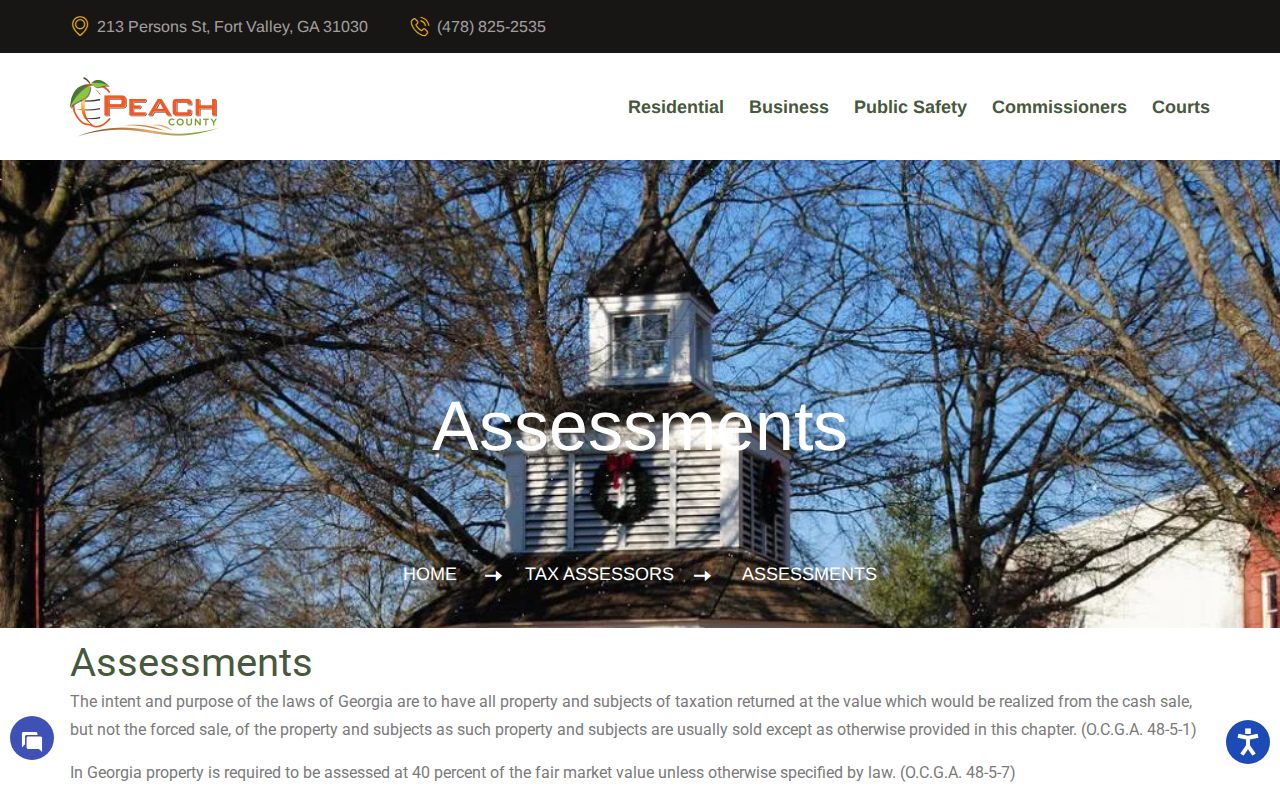
A Peach appeal starts with the notice itself. County material allows 45 days for a written appeal, though the current notice controls the actual deadline. The PT-311A form separates claims about value, uniformity, taxability, exemption denial, covenant breach or denial, and the owner's value assertion. Those grounds are not interchangeable. Verify the date yourself. Keep a paper trail. Save the notice date, appealed value, evidence sent, assessor response, hearing path, decision, and any Superior Court filing. Comparable sales, photos, a survey, income facts, or an appraisal may support the case, depending on the ground claimed. The Peach assessment page gives the official county source.
Procedures change. Recheck the county source for each year under review, since dates can shift from one cycle to the next. That one habit prevents most missed deadlines.
Fort Valley and Byron Files
Municipal limits add a second records layer. Fort Valley and Byron keep their own zoning, rezoning, variance, annexation, plat-review, permit, and meeting files for land within their authority. Neither city site offers a full parcel-by-permit database. Start with the county parcel and deed systems. Verify the city boundary and tax district next. Then request the city file with the address, APN, project name, and date range.
A mailing city or ZIP proves nothing about jurisdiction. Fort Valley's verified ZIP is 31030 and Byron's is 31008, yet postal geography can cross a legal line. The assessor supplies the situs, while an effective map or annexation record fixes the city limit. The assessor or bill gives the tax district. That layered check matters most near growth corridors and recent annexation activity.
Peach Plats Name the Land
A subdivision name can unlock a stalled search. Recorded legal notices in Peach County name Hidden Forest, Old Oak Section 4, Brandon Hills North Phase III Section II, Tucker Estates, Shady Acres, Byron Estates, Sherwood Forest Phase 3, Manchester Estates Phase 1, Hunter's Ridge Phase 2, Jackson Heights, Lewiston Heights Section 2, Hawks Ridge Phase 2, and Willow Lake. Treat each as a lead. None is a complete county inventory. Start with GSCCCA Plat Name or Book Page mode. Then record the plat date, subdivision, phase, section, lot, block, roads, easements, drainage notes, dedications, restrictions, adjoining lands, and any revised plat. Compare the plat to the deed description. Check it against the assessor map too. Some city concept plans and review drawings were never recorded. Label such documents by their true type.
Before Peach County Existed
Peach County was created in 1924 from parts of Houston and Macon Counties. A land chain crossing that year may fall out of the Peach index. The tract itself stayed put. Search the parent county books for the legal description, land lot, district, owner names, and referenced prior deed. The Georgia Archives Peach county card is a finding aid for county creation, court history, record series, and microfilm clues.
The statewide GSCCCA transaction index only starts in 1999. It is not a full historic chain. Older deed books, tax digests, probate material, microfilm, local libraries, and Georgia Historic Newspapers can supply leads. Preserve reel, folder, year, edition, and page data. Confirm names and land descriptions in an official instrument.
Missing Peach Records by Request
When a portal fails or omits a file, the Peach County Open Records request is the fallback. Georgia's framework generally gives an agency three business days. It must then produce records or state a timetable, cost estimate, and lawful basis for withholding. The first 15 minutes of search time are free. A lowest-qualified-employee rate and copies up to 25 cents per page may apply. Electronic production should be used when practical. Ask for existing records, not a new report.
Provide current and old APNs, situs and former street names, owner or party names, subdivision and lot, land lot and district, book/page, instrument or permit number, a tight date range, and the needed document types. A partial answer deserves follow-up. Ask which custodians were searched. Ask whether the item is not maintained, not located, exempt, or only available in person.
Peach Filing Alerts
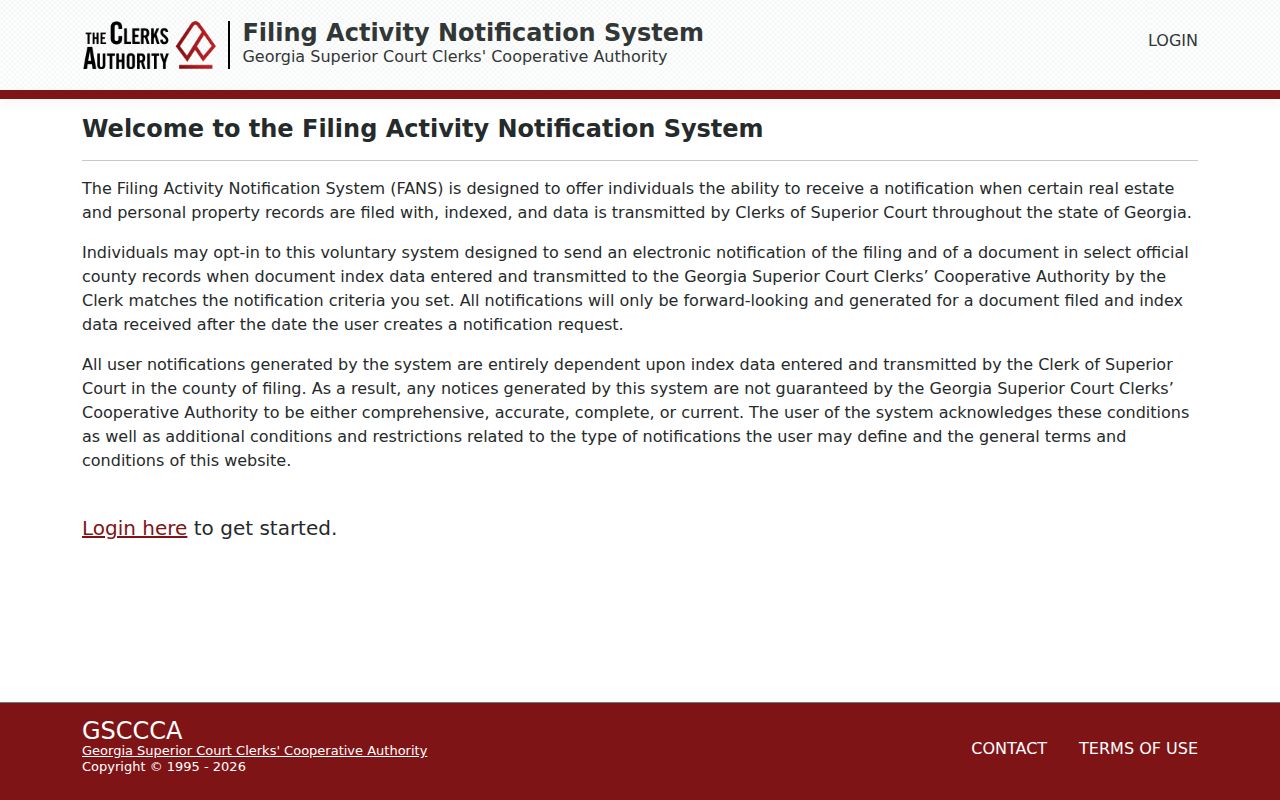
Georgia's free GSCCCA Filing Activity Notification System is called FANS. It watches for new filings tied to names, addresses, and document references you choose. Think of it as a watchman, not a verdict. An alert tells you something was filed. It does not prove the filing is valid. It also never replaces a deed search through the Peach County Clerk's records. Registrants get the most from it one way. The owner-of-record spelling and parcel references should be confirmed first.
State fraud guidance connects FANS to a broader identity-validation effort. That effort took effect January 1, 2025. When an alert lands, inspect the actual filing and contact the Clerk or qualified counsel. The official FANS registration page displays the sign-up form for enrollment.
Treat any alert as a prompt to dig deeper. The recorded instrument and its custodian remain the real authority on the filing itself.
Limits of Peach Property Records
Peach County property records answer many questions, but not all of them. One source may show the assessor owner display, while another holds the recorded deed transfer. A tax value sits in the tax roll. A plat reference lives in the Clerk's deed records. A permit rests with the city, a lien with the recorder, and an old name in a legal notice. None of it merges into guaranteed title.
Weak spots exist. Deed indexes can go stale or mis-index a name. The assessor may publish a value card without a deed image. A library clipping can surface a name yet prove nothing about ownership.
For a purchase, estate, boundary, or easement question, read the instruments and hire the right help. A survey settles lines on the ground. A title examination traces the legal chain. An appraisal fixes value. A public GIS map or portal screen cannot do that work.
Lawful use. Peach County records support land research, due diligence, estate work, and civic review. Never use owner information to stalk, target, or harm a person.