
Trace Peach County Former Owners Through Time
Begin with the most recent Peach County deed. Treat each earlier transfer as its own piece of evidence. Different tools cover different eras. The local Clerk portal, the statewide GSCCCA index, recorded plats, and archive finding aids each answer different questions. Index starting dates mark what a given source actually covers. Not every image is online. Older volumes may still require a trip or a request. Follow the land, and let each record confirm the last.
| Source | Years It Covers | Where Held | What It Shows |
|---|---|---|---|
| GSCCCA real-property index | Statewide index from 1999 | GSCCCA Search | Grantors, grantees, book/page, instrument and property modes |
| Peach local land portal | Certified-date menu begins in December 2017 | Clerk land records | Party Name, Party Name Plus, and Volume/Page routes |
| Older deed books and microfilm | Before online coverage | Clerk and Georgia Archives county card | Earlier conveyances and historical locators |
| Parent-county records | Before Peach County formed in 1924 | Houston or Macon County books | The same land under an earlier county jurisdiction |
A recent transfer usually shows up online first. When an image or an older volume is missing, the Clerk's office is the next stop. Trails that reach back before 1924 need extra care. Take the land lot, district, legal description, and the prior deed reference into the Houston County and Macon County records. The Peach County name alone will not carry the search that far back.
Peach County's Backward Deed Timeline
Keep every conveyance in order, and record the index spelling separately from the wording on the recorded image. A timeline built this way shows breaks and jumps clearly. The chain must follow the land itself, never just a matching surname.
| Transfer date | Grantor to grantee | Instrument | Locator |
|---|---|---|---|
| Newest recorded date | Prior holder to current grantee | Read the stated deed type | Instrument or book/page |
| Earlier acquiring date | Earlier grantor to that prior holder | Check warranty, quitclaim, estate, tax, or corrective context | Referenced prior deed |
| Subdivision origin | Parent tract to lot owner | Deed plus plat | Plat book/page and lot/block |
Report consideration exactly as the instrument states it. A nominal amount, a family transfer, a tax deed, or a correction is not an ordinary market sale. Note the difference in your timeline.
Peach County Names That Break a Simple Search
Party-name searches fail for predictable reasons. Initials, former surnames, entity punctuation, trusts, and estate capacities all hide transfers. A plain owner query misses these. Adding terms such as trustee, executor, administrator, guardian, or successor can surface the deed you need. For an LLC, compare the deed name against the Georgia business search. Entity status alone proves nothing about title.
- Grantor
- The party conveying an interest in the instrument.
- Grantee
- The party receiving the interest stated in the instrument.
- Reverse index
- A route that helps find when a named party conveyed property.
- Chain of title
- The ordered sequence of instruments affecting the same land.
Note: A signer for an estate, trust, or company is not automatically the individual owner of the land.
Reconstruct Peach County Previous Owners in Reverse
The newest deed names the first former owner as its grantor. Search that grantor as a grantee next. That search shows how the same parcel was acquired. It also names the owner before that. Legal descriptions, subdivision references, and prior-deed citations keep the trail on the right land. They matter whenever surnames repeat across Peach County deed books.
- Use the assessor lead and latest deed reference to identify the current instrument.
- Read the image and record the grantor, grantee, legal description, recording date, and locator.
- Search the grantor as a grantee, then compare the legal description before accepting the earlier hit.
- Repeat until the online index ends, then request the cited deed book or archive material.
- Book and page
- A locator for the recorded volume, not a complete title statement.
- Legal description
- The land lot, district, lot, block, subdivision, plat, or metes-and-bounds wording that ties transfers together.
The Pre-2001 Peach County Number Trap
The Tax Commissioner offers a warning about identifiers. Map, parcel, and account numbers used before 2001 may differ from current ones. The same property can carry two numbers. That single warning explains many apparent gaps. Build a crosswalk instead of guessing. List the current APN beside the older number, the owner, deed book and page, land lot and district, subdivision, lot, street, and source year. Numbers change for reasons that are not errors. A map conversion can produce a new identifier. So can a split, consolidation, replat, road project, or annexation. When an old number returns nothing, search the name and legal description. Ask the assessor or Tax Commissioner whether a historical cross-reference exists.
Plats Keep Peach County Past Owners on the Same Land
A recorded plat separates one lot from a similar street address. It also separates the lot from the larger tract that existed before subdivision. Peach legal notices name subdivisions such as Byron Estates, Hunter's Ridge Phase 2, Hawks Ridge Phase 2, Lewiston Heights Section 2, and Willow Lake. These come with plat-book references. Those names are search seeds. The recorded image still controls. Record the subdivision, phase, section, lot, block, roads, easements, dedications, and any amendments. Then compare the plat against every deed description in your former-owner timeline. A planning plan or site plan is not necessarily the recorded plat.
Estate and Trust Transfers in Peach County History
Ownership can pass without any sale. Land moves from an individual to an estate, a personal representative, a trustee, or a company, and the deed shows the capacity. Search the capacity words, and locate any appointment or authority record the deed references. A death record alone conveys nothing. An assessor name alone explains no legal path. Preserve the exact instrument type. Administrator, executor, tax, corrective, quitclaim, and warranty deeds mark very different events. When a chain rests on probate authority, use the Peach County Probate Court and Clerk records that tie the representative to the conveyance.
Archive Clues for Peach County Former Owners
The Georgia Archives tax-record guidance reports that digests from 1872 through 2002 are nearly complete statewide, often arranged by militia district and rough alphabetical order. A digest places a name in a time and area. It never replaces the deed chain. Spelling variants and defaulter lists demand extra care. Peach Public Libraries and Georgia Historic Newspapers can supply former street names, subdivision notices, and local context. The 1969 fire hit the Thomas library's courthouse-annex location. It is not proof that county land records burned.
Resolve Conflicts in Peach County Ownership History
Former owners rarely match perfectly across the assessor roll, the tax bill, the deed index, and the recorded instrument itself. Note each source first. Write down its date and its exact wording. Then weigh the likely explanations. The assessor can lag behind a recent transfer, a tax notice may list a record holder simply for collection, and an index clerk may have shortened a name. The deed image and its legal description carry the most weight on the actual conveyance. Even so, a deed can cite a correction, reservation, exception, or earlier instrument. Those referenced documents need reading too.
When two Peach County records disagree, keep them separate. Build a discrepancy row instead of merging anything quietly. List the source, the as-of date, the name, the APN, the legal description, a deed locator, and the open question. A later corrective deed, probate appointment, release, tax deed, or redemption may resolve the gap on its own. If the public indexes still leave ownership uncertain, take the file to the Clerk and a Georgia title professional rather than guessing.
Search Every Access Route for Peach County Prior Owners
The GSCCCA index is one channel, not the whole record room. The Clerk's local portal offers Party Name, Party Name Plus, and Volume/Page modes. It requires a username or PIN. Ask the office about account setup, in-person viewing, historical-book coverage, and copy options. A cited volume may sit outside the online index. Request it by county, book, page, party, recording date, and legal description.
The official GSCCCA search portal is the statewide starting screen for deed records.
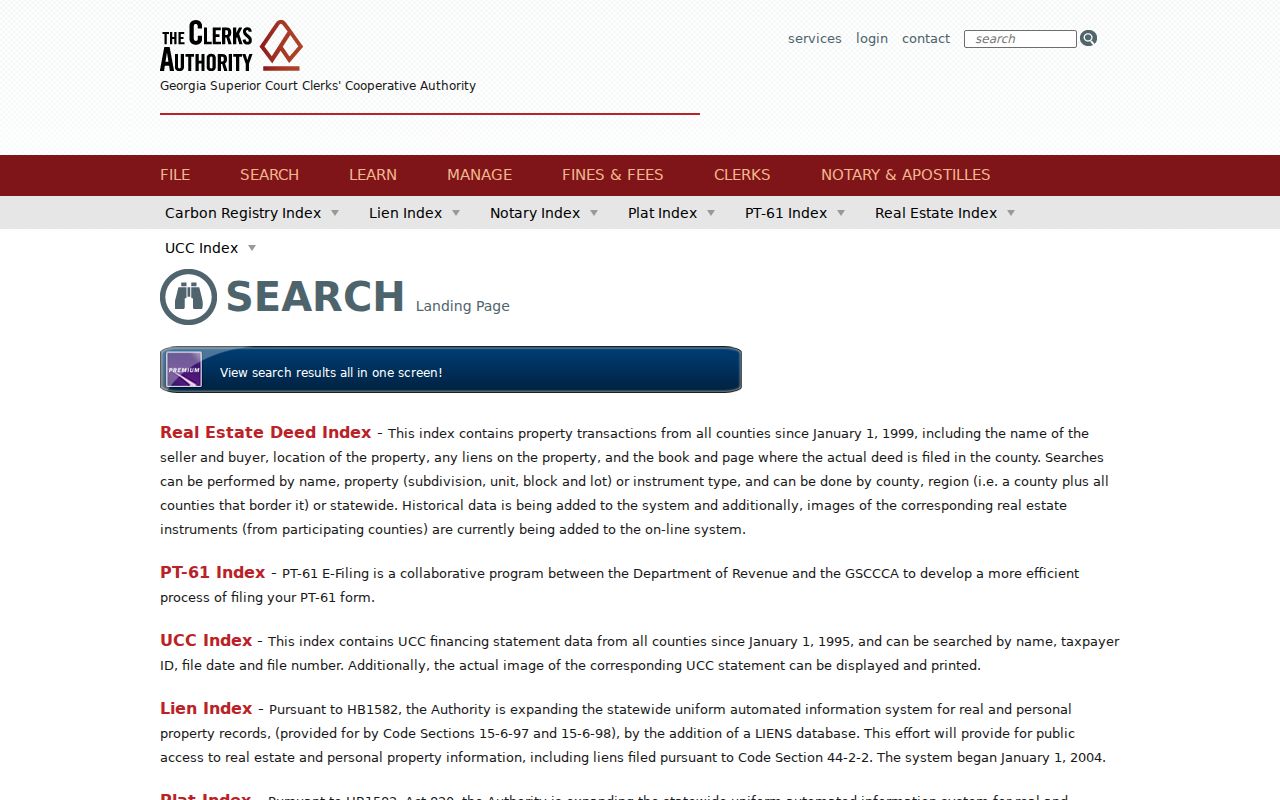
A portal hit is only a lead. You still need the recorded image and the Peach County legal description. Together they confirm the document belongs in the ownership chain. Older research calls for other channels. Georgia Archives finding aids and tax-digest material can anchor a deed search before modern indexing. Peach Public Libraries and historic newspapers reveal former street names, public notices, and subdivision names. For a county record absent from any portal, file an Open Records request with a tight date range and every known identifier. These fallbacks matter most when an APN changed. They also help when the ownership trail crosses the county's 1924 creation.
How Far Back Peach County Ownership Records Reach
The GSCCCA statewide real-property index starts with transactions recorded on or after January 1, 1999. Peach County's local portal shows certified dates in December 2017 for deed, lien, and plat categories, though menu dates prove nothing about the earliest surviving record. For older deed books, images, in-person access, and copies, ask the Clerk of Superior Court.
Peach County was created in 1924 from Houston and Macon Counties. A genuinely old ownership history may therefore leave the current county index entirely. The legal description, especially the land lot and district, is the stable bridge across that line. Archive cards and tax digests help pinpoint the right series. The parent-county deed book then supplies the actual conveyance.
Online coverage has limits. A missing online image is not a missing deed. Continue through the Clerk, deed books, archives, and parent-county records, and never use former-owner data to harass or target a person.